Saturday, June 29, 2024

Reviewing Dune by Frank Herbert


This is one of those books that is so iconic that my own opinion of it is more or less irrelevant. Still, I suppose it won't do any harm to review it here, so let's go.

If I recall correctly, I first read this book in 7th grade, which is now over thirty years ago. (You may be surprised if you watch my videos. I'm older than I look.) The main thing I remember from all that time ago was realizing, Oh, this is what politics is, that is, people maneuvering and jockeying for power, making alliances with people not because they liked them at all, but because they're useful in some fashion. I also remember liking it. I wouldn't say it was my favorite, but I did eventually read all six of the books by Frank Herbert.

So obviously part of the reason I reread this is because of the recent movies. I'm not sure if I would have reread it if it were only the movies, though. Another part of it is that I listened to an episode of Stefan Molyneux's show where he pretty much dumped on Dune for 45 minutes straight, which was amusing. So I also wanted to see if his criticisms held any weight.

So to compare it with the two recent movies: The first movie is actually fairly accurate. They cut some things for time, but that's expected. The feel and general story of the movie match fairly well, though.

The second movie, on the other hand, goes on a very different track, and mostly not a good one. The most obvious and indisputable change is the chronology. In the book, Paul Atreides and his mother are living among the Fremen for about 3 years by the conclusion. In the movie, it all takes place in less than a year. This, frankly, makes the Fremen look like children if they're willing to follow him that quickly. Also, there is no imaginable way to organize a planet-wide rebellion that quickly.

Second, the character of Chani from the books to the movie is unrecognizable. In the books, she does do some fighting (especially after being trained in the Atreides/Gesserit martial arts), but she is mostly a wife and mother. She loves and supports Paul. In the movie, she is a defiant girl-boss who is scowling something like 75% of the time. You could take the most attractive woman on earth and she would be unlikable after that treatment.

Regarding Mr. Molyneux, I must agree that the sandworms are difficult to understand. What could they possibly eat? While I'm reading the book, though, I can suspend that level of disbelief just fine for the sake of the story. Honestly, I think much of his dislike stems from his serious distrust of any kind of mysticism (with understandable reason).

My own overall opinion of the book itself? I enjoyed it. It's still worth reading, and if you haven't, I'd recommend giving it a try. If I recall correctly, the next two books are also good, but after that it kind of goes off the rails.

Friday, April 26, 2024

Reviewing After Dark by Manly Wade Wellman


After Dark is the second novel of Silver John by Manly Wade Wellman.  Silver John is a wandering bard in mid-twentieth century Appalachia. He also is a frequent combatant against supernatural evil of all kinds, which he once again crosses paths with in this book.

In this case, John and a few friends are facing off against the Shonokin, a clan of creatures who aren't quite human and claim to predate humanity. Using intimidation and witchcraft, they have slowly driven out the inhabitants of a small town, replacing the town with something creepy and entirely alien. In this book, their goal is to take the land (and daughter) of Ben Grey in a bid to further increase their sorcerous power.

Over the course of the book, John and Ben Grey must face down not just the monstrous Shonokins, but the cowardly and greedy human neighbors willing to collaborate with monsters for just a little profit. The last half of the book is John and his friends besieged overnight by the Shonokins and their witchcraft, facing them down with guts, guns, and a few bits of spellcraft of their own.

It's a distinctly small-scale, local story with possible implications for the whole world, which is a pretty good way to create real emotional stakes, in my opinion. No one fights to "save the world" because no one actually knows "the world." People fight to save this house, this town, this family of their own. Connecting that to a greater catastrophe down the line is fine, but the real story, the real fight, is the fight for your own home that you know and love.

Manly Wade Wellman continues to impress. Go get a copy for yourself and enjoy this tale.

Sunday, March 17, 2024

Reviewing The Old Gods Waken by Manly Wade Wellman


I found this book because of Dungeons & Dragons Appendix N, which I know about thanks to Jeffro Johnson. He deserves a great deal of credit for drawing attention to these stories, so be sure to check him out as well.

The Old Gods Waken is the first novel following Silver John, whom Wellman had already written several short stories about. The story is about an Appalachian hillbilly and an American Indian facing down two English druids who were trying to raise the old god Baal in America. Appropriately for the setting, it starts off with a dispute over a property line.

In terms of plot, this is a classic adventure story in which the two heroes must overcome a variety of obstacles to rescue their friends from being sacrificed to a devil. They face several kinds of dangers, some relatively mundane and some outright supernatural. It’s a fun tale.

At least as much as the plot, though, I love the Silver John stories for the language. They are written in a backwoods Appalachian dialect that gives them a distinct flavor without ever becoming obtrusive or veering into mockery. If this were any other group of people (e.g. blacks, Hispanics, Arabs), Wellman would be celebrated for authentically capturing the voice of a people. But since they’re white, our “intelligentsia” are completely uninterested.

It's also fun watching two men face down Baal armed with, among other things, a medieval Christian prayer from Albertus Magnus.

It's a fun adventure story. It's nothing philosophically deep, but it's a good time, and, unlike most things published today, it's not spiritually toxic.

The book is somewhat difficult to get ahold of, although you might check here, if you’re really interested, you might take a look over here. (But I didn't tell you that, okay?)

Just to give you a sample, I'm going to include a couple of quotes from a scene where the two heroes are facing down a crowd of American Indian vampires called Raven Mockers.

John: "I don't rightly know if you're the meanest one in this crowd, but I reckon you're sure God the ugliest. Nobody can deny you that." And a little later: "Come ahead, and don't stop and tarry by the way. You're a-looking for trouble, and I've got a good lavish plenty of it for you, right here and now."

A lot of fun, I highly recommend. Go read 


Friday, February 2, 2024

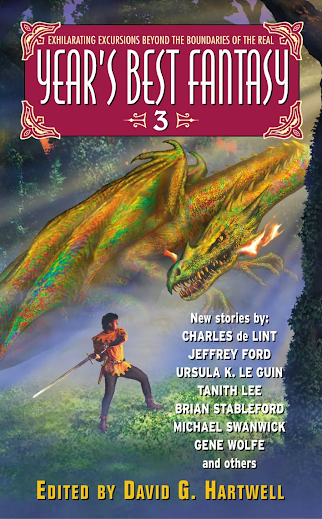
Finishing my review of Year's Best Fantasy 3

"A Prayer for Captain La Hire" by Patrice E. Sarath - This is a story of four of the companions of Joan of Arc years after the war. It is based on real historical characters and facts about their life.

It is not just good, not just fantasy, it is a Christian story. I am stunned. It may be worth the entire rest of the slag heap to have found this. (Yes, it's not all been a slag heap, but much of it.)

"Origin of the Species" by James Van Pelt - Theoretically, this is a story about a young werewolf, but that's a paper-thin cover for a story about adolescence and romantic jealousy. For good measure, it has a nice helping of "this woman don't need no help from a stupid man" at the end.

Look, I don't mind symbolism and allegory, but I do mind the author standing over your shoulder the entire time pointing and saying, "It's a metaphor. Do you get it? It's a metaphor for [insert subject here]."

Again, a good fantasy story should take us out of our world into something strange and wonderful. This story, like a couple of others in this anthology, instead takes magic and makes it humdrum and everyday. It's just . . . *sigh*

"Tread Softly" by Brian Stableford - In England in the aftermath of World War I, a gravely-injured war medic finds a rare magical artifact that can influence dreams. This one appears to be corrupted, but he makes restoring it his mission in life. However, a series of disasters befall him and those around him and he ends up losing even that.

It's fantasy. It's not just an obvious metaphor for some other issue. It's even modern fantasy, and genuinely creative, which makes it a cut above at least half of this book.

But...

I hate the main character/narrator. He is solipsistic and self-righteous to an unbelievable degree. Possibly Stableford intended him to be unlikable, in which case, he succeeded, but I find it difficult to enjoy stories with such an unlikable main character.

For comparison, try to imagine the inside of Gollum's mind. That's about how slimy this guy feels.

Interesting premise. But, wow, what a horrible person the narrator is.

"How It Ended" by Darrell Schweitzer - A medieval lord and knight returned from the crusades is troubled by terrible dreams and discovers that his life is not what he thought it was.

At the start, I thought this was going to be "middle ages stupid, Christianity bad, crusades evil" ham-handed propaganda. We've certainly had some like that in this collection. I was mistaken. I feel a little troubled by the ending, but it's definitely not the cheap, stupid propaganda piece I had feared.

"Hide and Seek" by Nicholas Royle - A fairly short horror story. Horror, of the right variety, is a kind fantasy. Ok. The concept is a disturbing one. But for some reason, and maybe it was just my own mood, it just did not land for me. I see what he was aiming for, but it just didn't work. Maybe that was on my end, though.

"Death in Love" by R. Garcia y Robertson - It's hard to explain how obnoxious this is as a finish to the book. It took me a while to recognize it, but the main character is a hard Mary Sue. She is the ruler of an island keep guarding the straits to a sea which is an important trading zone. She is supposedly the demi-goddess of death, but that appears to be merely a title, as she has no supernatural capabilities. Everyone treats her, though, as if she is some mystical creature.

She is fantastically good at everything: She is a diplomat, a warrior, a doctor, a ruler, and great at all of them, and all men desire her. Also, literally everyone, including rulers of tribes she had only heard of three or four days ago, recognizes her on sight and respects her. Even if she was some marvelous being, this is not how the world works before modern communication methods.

The only reason this story is in this book is because it's childish feminist trash.


So, what's the verdict on this book as a whole?

It is a disaster. I count seven stories that are worthy of any kind of recognition. Seven out of twenty-nine. A few of the stories here are pure political poison. A lot of it is just stupid and boring. "Aren't I clever. It's a metaphor. Do you understand the metaphor?" Yes. You have all the subtlety of a two-year-old running around with a hammer.

There were a couple of bright spots. But it was like finding a diamond underneath an outhouse. You have to sort through a lot of excrement to get there.

It seriously makes me wonder how I didn't see how bad some other things published around the same time were. It's all managed by the same people. Much of it had to be the same dross.

Those people are not going to change. If we want better, we must look elsewhere, build elsewhere, and vigilantly keep them out.

As a final note, be sure to read A Prayer for Captain La Hire. It is excellent, and a gem among this trash heap.

Thursday, January 25, 2024

Continuing review of Year's Best Fantasy 3 - Part 4

 "Sam" by Donald Barr - A man finds himself fading out of existence after being fired from his job and forgotten.

Fantasy? Yes, shading into a weird kind of horror, but yes. Well-written? Yeah. Good story, creepy. Not political message fic.

Although it's not presented this way, it would be easy to tweak this into terrifying horror.

"Persian Eyes" by Tanith Lee - A high-ranking Roman in the imperial period finds a new slave girl much more than he bargained for, to his destruction.

I haven't read much Tanith Lee, but I've heard high praise of her. This is a) very good and b) actually fantasy, transporting me to another world both in terms of time frame and in terms of supernatural threats. Subtle and creepy. Very good.

"Travel Agency" by Ellen Klages - Very feminine. Very self-indulgent, self-insert. Barely qualifies at fantasy at all. Makes a metaphor literal at the very end. *le sigh*

Every single time.

"A Fable of Savior and Reptile" by Steven Popkes - A talking turtle (whose special qualities were not explained as far as I had read) finds and befriends Jesus as a child. He makes it very clear that Jesus is the son of Joseph by a shotgun wedding (crossbow wedding?). John the Baptist is a teenaged sadist. I quit because I see no reason to subject myself to further abuse.

Yes, you're very brave satirizing Christians, who are the target of the monsters in power. You're so very clever telling this from the perspective of a talking turtle.

Once again. This was the "best" of this year?

"Comrade Grandmother" - From the introduction, I was expecting this to be awful. I was expecting Mary-Sue feminist bullshit. I was pleasantly surprised.

This is a story of a woman trying desperately to defend her homeland from invaders and slowly selling herself to an ancient witch to do so. In many ways, it feels like a real fairy tale. It's not easy. It's not pretty. In some ways, it may have been a terrible idea.

The only thing that makes this a little annoying is that the homeland is communist Russia and the invaders are, of course, the evilest people in all history (history history story ory), the Nazis. But, to an ordinary Russian, it was still their home, and it was still an invading army, so I can't really blame them for that.

"Familiar" by China Mieville - An urban horror story. It's never made clear exactly how different this world is from our own. A small-time witch in London summons up a familiar. He soon finds it is not remotely what he expected and is costing him far more than he bargained for.

Fantasy? Check. Intriguing, in a gross and disturbing way? Check. The best point in its favor is that it genuinely has an old-world fairy tale kind of feel: Play around with dark powers and you are going to end up somewhere you very much don't want to be. 

I can't honestly say I liked it, but I also can't say it was poorly done.

"Honeydark" by Liz Williams - A man flees a high position in politics into anonymity in a small village. He finds both a safe haven and a terrible secret.

This feels like it's part of a larger story, like there's a novel or series of stories it's connected to. It's not that it's incomplete, but the scale of the implied background seems to say there's a lot more to this world and it's not a standalone story.

Is it fantasy? Yes. Is it poisonous political propaganda? No, or if so only a bit. It reminds me just a little bit of the story of The Wicker Man. No, I haven't seen it, but I know the basic plot.

I didn't love it, but it also didn't repel me. For this collection, that's a win.


There are six more stories (125 more pages) left, so my next update should be the last.

It's really sobering to realize this was 20 years ago and the trajectory has been only downhill since.

It's also sobering to realize that until fairly recently, although I didn't much of this stuff, I didn't recognize how it fit in terms of a larger picture.

The people who have done this to our storytelling are evil. Flat out, no sugarcoating, no excuses. These people are evil. If you are a sane, decent Christian, they hate everything that matters to you.

We can't accept this. We have to take our storytelling back.

Friday, January 12, 2024

Continuing review of Year's Best Fantasy 3 - Part 3

"Social Dreaming of the Frin" by Ursula K. Le Guin - A quasi-sociological report on the people of the "plane" (which term is quite vague) of Frin who share one another's dreams. An actual fantasy story, and actually well-written.

There's no overt political messaging. If I didn't know previously know about it, I don't know if this would occur to me, but Le Guin was interested in Buddhism, and this does have significant Buddhist overtones. But it's not grotesque message-fic. It's a good story which also conveys the author's values. Even if I don't agree with those beliefs, I cannot say this is badly done.

"Five British Dinosaurs" by Michael Swanwick - I can't really call this a story. It's five separate tiny vignettes about dinosaurs. Some are fantasy, kind of. Some are just stories. There's barely enough in any one to actually call it a story. This seems more like a gimmick than fiction.

"The Green Word" by Jeffrey Ford - On the positive side, this is a fantasy story. On the negative side, this is ham-handed message fic. It is about mean, evil Christians in the middle ages persecuting wise, decent pagans. The pagan witch is a Mary Sue with unexplained fantastic physical abilities. The evil Christian king is literally named King Pious. He has no redeeming qualities whatsoever. He is stupid, selfish, hypocritical.

I can read well-written stories by people I disagree with, even appreciate them. This is trash which a reader will only like if he already agrees with the message.

"The Comedian" by Steve Chapman - This is an actual fantasy story about a family with a variety of psychic talents. It's not bad. It's very character focused, in a way that to me, smells a little of someone who wishes he were writing "literary" fiction but has decided that it's easier to get published in genre.

Actually fantasy, not overtly offensive. On the high side for this book.

"The Pagodas of Ciboure" by M. Shayne Bell - A very sick little boy in France (apparently leukemia, although not named most of the story) goes with his mother to the countryside to recover. While there, he meets some magical creatures called pagodas who, legend says, have healing powers. They help him and he ends up helping them, and growing up to be someone quite important.

Really good, actually. Again, no political nonsense. Almost an old school fairy tale. This may be my favorite story so far.

"From the Cradle" by Gene Wolfe - A young man who works in a book shop becomes interested in a rare book that is for sale on consignment. Although he can only see a page or two at a time, he becomes fascinated by its stories, which turn out to be a trail of breadcrumbs leading to . . . something else.

An odd mix of fairy tale and science fiction. Wolfe doesn't provide a complete picture, but a series of dots, and trusts his reader to find the whole. I'm quite certain I missed some things the first time through and should re-read this.

Excellent story.


So, I am currently halfway through by page count and just over halfway through counting by stories. What's the score so far?

Out of 15 stories:

Stories that are not fantasy or only maybe fantasy if you squint at it the right way: 6

Stories that are toxic political propaganda (some overlap with previous): 4

Just plain good fantasy stories? 5

Was this the best short fantasy fiction of 2002? No. I'd bet my life no. If I could still find it, I'd bet I could find stories written by nobodies on the internet from that year that were far superior to most of those published here.

It's stunning to me now, to see how far things had fallen already 20 years ago, and I hadn't even noticed it. And, as far as major publishing houses and such go, it's only been downhill since.

We can't accept this, and we can't wait for someone else to fix it. We have to create and support the culture we want.

Speaking of, you might take a look at my own book: The Mayor of Christ Mountain.

Thursday, December 14, 2023

Continuing the review of Year's Best Fantasy 3 - part 2

So let's see what other wonders this book of "the best" fantasy stories of 2002 has for us.

"A Book by Its Cover" by P.D. Cacek - In Nazi Germany, shortly before the Holocaust begins in earnest, a Jewish bookshop owner finds his store, which the Nazis had raided and burned all his books, can turn people into a copy of their favorite book, from which state they can be recalled. He uses this to help Jews escape the e-e-e-evil Nazis.

I found this story annoying at first, but after a while, it was actually pretty funny. Once you've grasped that the event in question simply did not happen, the propaganda about it can be humorous. In this case, you have to accept that the Germans this boy knew, for no reason at all, became seized by an insane hatred. They are literally cartoonishly evil. The author does not have the main character's former friend, now Nazi, actually twirl his mustache while cackling maniacally, but he may as well have.

The only reason stories like this get by is because they are coasting on a huge swell of emotional manipulation. But if you're free of that, it's quite funny how empty they are.

"Somewhere in My Mind There Is a Painting Box" by Charles de Lint - Holy crap! It's an actual, unambiguous fantasy story...and there's not some wicked political message thinly disguised...and it feels like a fairy tale, with the same kind of dangers of fairy land that stories all the way back to the brothers Grimm might warn of. I'm shocked.

Good story. This is the first good unambiguous fantasy story I've seen here so far, and I'm almost a quarter of the way through the book.

"The Pyramid of Amirah" by James Patrick Kelly - Fantasy? Check. Good? It's interesting and well-written, at least. For a late-twentieth century atheist, this is a pretty good take on religion. So, yeah, it works.

"Our Friend Electricity" by Ron Wolfe - A middle-aged low-level book editor has a whirlwind romance mostly at Coney Island with a pretty twenty-ish young woman. The main character may murder someone with a skee ball. Near the end, he either has a vision of the past or travels back in time briefly for no clearly explained reason.

There are some genuinely poetic passages here, but by the end, it feels self-indulgent, writers writing about writers, for one thing. Also, the "fantasy" element enters late, and is vague and poorly integrated with the rest of the story. This is not a bad story, but it's terrible fantasy.

Again, I grow weary of being sold "It might be fantasy if you squint and look at it from a certain angle." Writers and editors, if you don't want to write fantasy or science fiction, that's fine. You don't have to. Don't write it. But please do not write mundane "literary" fiction, barely dress it up, and try to sell it to me as "fantasy."

I am now about 1/3 of the way through this book and I have found 2 stories, only 2, that are actually good, and actually fantasy. I get the impression Hartwell knows better and I can only attribute this disaster to the co-editor Kathryn Cramer.

Hmmm, Cramer? Oh, every single time.

I will soldier on and complete this review, possibly by the end of this year.

Wednesday, December 13, 2023

A rolling review of Year's Best Fantasy 3 - Part I


In an ongoing effort to be as irrelevant as possible, I'm going to review the anthology I'm currently reading, Year's Best Fantasy 3 edited by David Hartwell...which was published 20 years ago. I haven't finished it yet, but I'm going to do a rolling review of the individual stories as I go.

These stories were first published in 2002. If these were, indeed, the best fantasy stories published that year, then the fantasy genre was almost entirely dead. They weren't, of course. They were just the ones most politically fashionable. It was not nearly as bad then as it is now, but SJW corruption of science fiction and fantasy was already well underway.

I have no doubt that with money and time, I could create an equally long collection (~490 pages) of actually good, actually fantasy stories that would sustain an actual fanbase. Of course, if I understand correctly, Amazon has destroyed the ebook market, but that's a separate question.

So, on to the stories.

First thing I did was browse the table of contents. I saw "Cecil Rhodes in Hell" by Michael Swanwick near the end. It was only a single page. I had an idea what I was in for, and I was curious, so I skipped to that.

This could barely be called a story. It is basically an encyclopedia entry (Wikipedia before that existed, kiddies) with a "white people bad" moral tagged on at the end. I am not kidding. It is garbage and the only reason anyone would publish it is because of a sick, seething hatred of white people.

Also, for anyone who wants to engage with the real world, Zimbabwe (formerly Rhodesia) is not doing well at all since they decided to kick out all of their white farmers, confiscate their land, and hand it over to blacks. Good. I hope they starve.

Going for a more standard reading experience, I returned to the beginning of the book for Kage Baker's "Her Father's Eyes." This is a story told from the point of view of a young girl on a train ride in post-World War II America. It is atmospheric and tense, and...debatably fantasy. There is nothing here that is absolutely distinct from our own world. It might be a fantasy story, but it could very well be just...bad people.

I hate these it-might-be-fantasy stories. If you're going to sell it as fantasy, make it fantastic, not, "might be fantasy, might be mental illness or a child's misunderstanding of the world."

It's not a bad story, but is it fantasy? Is it the best fantasy?

Next up "Want's Master" by Patricia Bowne, which is about academic politics and fundraising and growing old slightly dressed up in magical terms. Instead of taking us out of our own world into something exciting and fresh, Patricia opted to make magic boring and petty as office politics and gladhanding to raise money.

"October in the Chair" by Neil Gaiman - The months of the year convene to share stories. It's a cool setup. The personifications of the months are interesting. The story October ends up telling is a self-indulgent gamma poor-persecuted-me fantasy...in the worst sense of that word.

"Greaves, This Is Serious" by William Mingin - A send-up of P.G. Wodehouse's Jeeves stories. He makes a fair point, but it's fundamentally a mean-spirited shot at a much, much better writer, and, once again, barely qualifies as fantasy.

"Shift" by Nalo Hopkinson - Before I get to the story, I want to quote a bit from the author bio, "She is on the steering committee of the Carl Brandon Society, which promotes the involvement of people of color in speculative fiction." So yeah, you know what to expect.

In fairness, this is actually pretty well-written. It is, however, vile poison. It takes up the story of Shakespeare's Caliban centuries later. Caliban is a black man. When she arrived at the island, Miranda was so taken by this black man that she immediately decided to have sex with him, and then her father caught them and she accused him of rape.

Literally the entire point of the story is that white girls are desperate to get with black men, and somehow, it's white girls' fault that black men abandon those children. And black men are poor, persecuted victims of white people's perceptions who never did nothing wrong.

On behalf of the tens of thousands of white women in the U.S. raped by black men since this story was written, burn in Hell, Nalo. Burn in Hell.

And that's what I've read so far. It's gotten far worse since, but as you can see, our culture has been in deep trouble for some time now. There are also stories by Tanith Lee and Gene Wolfe in here, so there may be other worthwhile ones. I'm going to keep going, but, geez, this is bad.

Sunday, June 18, 2023

My (as yet untitled) story chapter 1

 So I've had this story idea in mind for a while. I've not actually done much on it, though. Here's what may end up as the first chapter (depending how chronologically I decide to tell the story.) Let me know what you think. If people are interested, I may start another blog specifically for this story (Book? We'll see).

Without further ado, our story commences:


It was just after 2:00 AM when the windows of Leonard Clump’s 27th floor law offices exploded out into the night, showering the streets below with glass and various fragments of desks, office chairs, and legal documents. Even the cleaning staff had gone home by this point, so nobody was harmed. Firefighters arrived at the scene within twenty minutes and police were investigating the next morning.

Len Clump himself was on CNN and MSNBC the next day denouncing the attack as obviously the act of a white supremacist seeking revenge on his persecuted black clients. “From Emmet Till to Rodney King to Treyvon Martin, we’ve faced senseless violence and hatred from the white man, and we’ve fought it with nothing but our own intelligence and determination. We will continue that fight.” It was in the news for two weeks, but then, as there were few new developments, faded away.

The Tallahassee police devoted all the detectives they could spare to the case, knowing that any misstep was likely to bring national attention. They had brief video of a suspect who may have planted the bomb, but weren’t able to identify anyone. The forensics lab was similarly stumped. The bomb, they said, appeared to have been deliberately constructed to destroy almost all of its primary components. Analyzing the explosives residue, they were able to track it to a package which was delivered to a post office box in Idaho over a year ago, and found nothing more.

So the event dropped out of the public eye. Apart from a few blogs and independent commentators, nobody thought much about it . . . until Clump died in an apparent car-jacking.

(3 years earlier)

“. . . and nothing but the truth,” Edmund Dantent finished, then looked around the courtroom. His throat was tight with anticipation of the questions he might have to answer. This week had been circled on his calendar for two months, although he didn’t know when his specific day would come.

Defense counsel Leonard Clump, standing at his podium, turned to look directly at Edmund for a moment before addressing him. His shaven black head gleamed in the courtroom’s bright lights.

Edmund’s eyes wandered to the defendant’s table, but he quickly looked away. He couldn’t look there, couldn’t think about that.

Clump tapped a button and put something on the screen on the far side of the courtroom. Edmund didn’t notice what it was as he was intently watching the lawyer.

Mr. Dantent, is this your Facebook account?”

“Yes, that looks like it.”

“And is this your post from August 17, 2014?”

The prosecuting attorney said, “Objection, your honor, relevance?”

Judge Liebowitz replied, “Overruled. Please answer the question.”

Edmund read the post to himself, then answered yes.

Clump read the post for the courtroom: “I don’t think this was murder. It looks to me like Michael Brown was attacking that cop. What was the cop supposed to do?”

Clump paused a moment before turning to the jury.

“This, ladies and gentlemen of the jury, is the kind of racism and bigotry that my client had to face on a daily basis in this neighborhood.”

“Obje—"

“Overruled. Please continue.”

“And this is the kind of racism and bigotry was coming from this very man before you, creating a toxic environment, damaging to my client’s mental—“

Edmund could no longer contain himself here: “What’s going on? I’m not on trial here! I am the victim!”

At the first word, Judge Leibowitz began banging his gavel. “Order in the court! You are not to speak unless answering questions. Please continue, counsel.”

Edmund sat in shock as the lawyer droned on, barely noticing what was said until the lawyer had to repeat his name several times for the next question.


Sunday, June 4, 2023

Reviewing The Great Divorce by C.S. Lewis


The Great Divorce is . . . *pauses to consider genre classifications* a theological fantasy novel by C.S. Lewis. The narrator finds himself standing in line for a bus in a vast, dreary town. The people he is surrounded by are cruel, arrogant, petty and quarrelsome. When the bus arrives and they embark on their journey, they find themselves in a bright, open field in a land awaiting the sunrise. They also find that this land is profoundly inhospitable to them. Compared to everything else here, they are wraiths so weak and insubstantial that even lifting a single leaf from the ground is beyond their strength. The grass is painful to walk upon because they can't so much as bend down the blades, and the points dig into their feet.

The Ghosts (for so the narrator dubs them) are soon met by bright Spirits, people to whom this land is home. The Spirits attempt to persuade them to stay and promise they will grow stronger and more real if they will. The narrator eventually discovers that this land is Heaven, the dull, empty town is Hell, and the Spirits are messengers sent to attempt the salvation of the damned.

The great majority of the Ghosts eventually choose to return to Hell. In order to stay, they would have to surrender their pride, their control over others, their "rights," or their hunger to feel like aggrieved victims.

Through the conversation the narrator witnesses, Lewis exposes many of the ways we choose to deceive ourselves and deprive ourselves of joy, both in this life and in eternity. He also shows how damnation is not merely a risk for murderers or robbers, but a very real threat to all of us who place ourselves and our will above God's plan for us, and how even petty sins, if not repented of, can finally destroy us.

There are a few pages here and there with what amounts to a mini-sermon or a lecture, but on the whole, the lessons of the story are taught through dialogue and interaction between characters. The whole thing is imagined and described in excellent detail, and there is one part that has, on previous reads, moved me near tears.

In case I have not already made it clear, I highly recommend this book.


Wednesday, May 17, 2023

Reviewing Titans of Chaos by John C. Wright


I feel a little awkward reviewing Titans of Chaos by John C. Wright. It's the third in a trilogy, and while I have read the other 2, it's been a couple of years. I ran across this one at a used bookstore not long ago, and decided to finish the story. But I'd like to make reviewing books I read a regular habit, so here goes.

The Chronicles of Chaos is the story of five children who grow up in a private boarding school in England. The main character is the ambitious explorer Amelia Windrose. Her friends are the stoic Victor Triumph, the melancholy Quentin Nemo, the rambunctious and hormonal Colin mac Firbolg, and the preening Vanity Fair. They soon discover that they are not ordinary teenagers, but have magical powers.

But their magical powers are not all the same. In fact, at least one of them scoffs at the very idea of magic, even though he can accomplish feats no human can do. They find that four of them have powers that can cooperate with two of the others and simply nullifies the last.

They eventually discover that they are not human at all, but children of the Titans held as hostage for the good behavior of their people. Their captors are the gods of Olympus, who created the world most of us know, which the Titans consider a foul prison.

This book tells about their flight from their captors and their fight to keep their freedom.

The characters

The characters feel real. They feel like real teenagers struggling to figure out their social standing and love lives. (Admittedly, they are also very intelligent and excellently educated teenagers.) They also feel like real gods manipulating vast powers who could wipe out an entire army of humans with little effort.

The Olympians they fight against also feel real people, power-hungry and engaged in very high-stakes political machinations. They, too, are trying to establish leadership after Zeus was assassinated, which kicked off the struggle which resulted in the main characters being taken as hostages. Some of them want to maintain the stand-off, and some want to initiate a theomachy which will likely result in the world we mortals experience being destroyed so they can remake it. Unfortunately for our main characters, killing them would be an expedient way to start that war.

The magic

The principles of the magic in this book are explained in broad outline. Exactly what is possible or not is not explained in detail, but the general nature of each character's powers and how they interact is given. To refer to other authors, it's not explained in the kind of detail of a Brandon Sanderson book, but in better detail than a Harry Potter book. Thus, the use of magic in this book generally feels satisfying, but you don't feel, in retrospect, that you should have predicted it, as you might in a Sanderson book.

The story

As is often the case with John C. Wright books, the story alternates between cataclysmic action scenes with potentially Earth-shattering (not an exaggeration) consequences and extended philosophical and moral discussions.

My evaluation

Overall, I highly enjoyed this book and heartily recommend it to anyone interested in intelligent science-fiction/fantasy. I fear my description of the book may be somewhat inadequate, but I'm trying not to spoil too much from previous stories in the series.

Friday, April 7, 2023

Not reviewing There Is No Antimemetics Division


I just finished reading There Is No Antimemetics Division. I will not be posting a review of it yet because I intend to hold a discussion of the book shortly. I will say for now that I highly recommend it, and if you find it interesting, you should listen to our discussion of the book when it is posted to YouTube and Odysee.

Monday, April 3, 2023

Reviewing There Will Be War Vol. II edited by Jerry Pournelle


This is the second in Jerry Pournelle's anthology series There Will Be War. Each book is a collection of science fiction stories and poems about war and its effects. These books also contain practical essays about military strategy.

The stories range from present day to decades in the future to centuries in the future. Being an anthology, it is a mixed bag. You're probably not going to like every single story, but if the idea interests you at all, you'll find something to enjoy.

This is the fifth in the series I've read, and I've liked all of them so far. Honestly, though, this is not my favorite. There's a lot of good stuff in here, but it's not the best of the series.

This book was published in 1984 and it's fascinating with hindsight seeing them so concerned about the arms race with the Soviet Union . . . which was very shortly to cease to exist. Also, they didn't notice what now appears obvious to be the downfall of the U.S. as a unified polity within our lifetimes: increasing racial and ethnic diversity.

My personal favorites:

"Manual of Operations" by Jerry Pournelle about a man who finds an abandoned flying saucer that he can only operate while raging drunk

"Superiority" by Arthur C. Clarke about why a military's technological superiority brought about it's downfall

And "'Caster" by Eric Vinicoff about how much influence the news media can have on success or failure in war.

On the whole, I highly recommend the series and middling recommend this particular volume.

Wednesday, March 15, 2023

Reviewing Time Cat by Lloyd Alexander


I recently read Time Cat by Lloyd Alexander. I was looking for a new audiobook and I liked Alexander because of his Prydain books. The audiobook I got was read by Ron Keith.

Time Cat is a children's novel about a boy named Jason and his time-travelling cat Gareth. It is episodic in structure, with the two of them journeying to various times and places throughout history, including ancient Egypt, late republic Rome, 1500s Peru, medieval Germany and others.

Honestly, I didn't enjoy this book much. The biggest problem is something I've seen in several children's shows, less so in books: so that the child protagonists have something to do, all of the adults tend to act like morons. Also, everywhere he went, people either had never encountered cats before or were strangely obsessed with them somehow.

Being a basically episodic children's novel, I expected it to have a kind of lesson with each incident, but either it didn't or the lessons just didn't make much impression.

Also, Ron Keith's reading here was unbearably cutesy. His voice tone was like a sweet chocolate bar dipped in syrup and rolled in brown sugar. It was far too much. I honestly don't think I could accurately reproduce this kind of performance. I suspect you could have Ron Keith read a graphic torture scene in a tone that would have you react with "A-a-aw" (in three syllables of rising tone). 

There are many children's books I've re-read and enjoyed as an adult. A well-written children's book can have a lot of depth. I did not find that here. If you liked this book as a child, sorry if I'm ruining your memories, but I did not like it as an adult.

Wednesday, March 8, 2023

Reviewing Star Light by Hal Clement


Star Light is a 1971 science fiction novel by Hal Clement. The novel is a sequel to his Mission of Gravity. In this book, an interstellar-exploring humanity is conducting a scientific expedition to a world named Dhrawn. This planet has a surface gravity forty times that of Earth, which is inconvenient for humans, but perfectly comfortable for their recent allies, the Mesklinites (encountered in Mission of Gravity). In collaboration with the humans, who have far superior technology, but physiology completely incompatible with Dhrawn, the Mesklinites are exploring the planet's surface. Even they are hampered by an atmosphere which contains oxygen, toxic to them, and must either work in sealed settlements and vehicles or in air-suits for extra-vehicular activity.

The story centers on Dondragmar, captain of one of the land-cruisers exploring Dhrawn. He repeatedly encounters unexpected obstacles in exploring the planet and must, with the help of human observers about 30 light-seconds away, protect his ship and crew from a world that nobody involved fully understands.

The most interesting thing about this novel, to me, is the hard s.f. aspects. Huge parts of the story turn on the chemical and physical interactions of atmospheric water and ammonia and the xenometeorology they create. Also quite important is the sheer physical distance of the humans' space station from the surface, which means even light-speed communication takes 30 seconds to go one way. I'm not aware of much hard s.f. being published these days, and it creates a very different feel to the story.

It does, however, have the usual shortcoming of such fiction: It doesn't have much in the way of character development. Practically, it seems like you could choose interesting, well-developed characters or profound technical competence in your story-telling. There are, however, interesting politics developed, both among the humans of the space station and between them and their Mesklin allies. The Mesklinites are quite happy to help the humans explore the planet, but have distinct goals of their own, some of which they hide from the humans, which, in turn, creates further dangers for them since they don't have high-speed communication of their own.

My verdict: It's a fun read and I like reading hard s.f. like this sometimes for the crisp, clean style of thinking. I wouldn't call it great literature, but not everything has to be. I enjoyed it, and I suspect someday I'll read this and the earlier book back to back. (I read Mission of Gravity several years ago.)

Sunday, September 5, 2021

My final thoughts on That Hideous Strength by C.S. Lewis

The book starts and ends with the subject of marriage. And Lewis was right, that is where much of the postmodern attack on our society is focused. Most Christians would agree on this (Those who do not, I fear, are dubiously to be called Christians.), but not all of us would agree where exactly it started. I am now Catholic partly because I think this started with the acceptance and widespread use of contraceptives. It's a strange thing. It seems like it should be fine, but it is amazing how destructive that is. Even if you set aside for the moment the poisonous effect of hormonal contraceptives (which is a horrifying problem that almost no one talks about), it is clear that the contraceptive attitude has wildly warped our society.

As I noted before, most of this book is a slow burn. I don't think that really bothered me before, but I definitely noticed it when I was carefully reading it chapter by chapter (and writing summaries for each section). And then there's an enormous explosion at the end, both literally and figuratively. In that, it reminds me a little bit of a Neil Stephenson book. I hear he's been infected by social justice thinking. That's too bad. He's a fascinating writer.

One of the interesting things about this book I noticed this time through is how Lewis explores different kinds of minds: animal & human, man & woman, modern & medieval, upper & lower class, and subject to various kinds of spiritual corruption. Is he perfectly accurate? Of course not, but it's interesting to contemplate.

This book also addresses what does evil look like in action. It's kind of interesting because both N.I.C.E. and the company of Logres have very vague expectations of the responsibilities of their members, but it works out so very differently in the two cases.

One flaw, which I had intended to mention in my comments on the final chapter, which I haven't made yet, is the idolization of the feminine. Lewis appears to fall victim to W.A.W., but nobody's perfect. Both Jane and Mark must make amends for their failures in the marriage, but these amends are very different in nature. Jane humbles herself before Ransom and God. She reluctantly, with some apparent distaste, humbles herself to her husband. Mark, on the other hand, when he realizes his error, is almost worshipful in his attitude towards Jane. This does not seem in balance to me.

One final note, an interesting progression I noticed in this trilogy:

Out of the Silent Planet - Unfallen

Perelandra - Will it fall?

That Hideous Strength - Fully fallen and with corruption almost entirely dominant

Perhaps that's part of why I like this one the least of the three (although I still think it's a very good book.)

We'll get started on Centrism Games shortly. I'll post the first discussion board either next weekend or the one after. Talk with you soon.

Sunday, August 29, 2021

Chapter 17 - Venus at St. Anne's

 Part 1 - Mark makes his way to St. Anne's, on the way, stopping at a hotel & reading a book he enjoyed in childhood.

Part 2 - The women of St. Anne's select formal dresses for the farewell to Ransom. They have no mirror, so they must each help the others select theirs, and admire them. At the end of the chapter, there is a great disturbance from the direction of Edgestow.

Part 3 - Feverstone, abandoning the wrecked car, makes his way towards Edgestow. On the way, he notices an unusual amount of traffic flowing the other way, but makes nothing of it. Just as he arrives, he finds himself caught up in a series of earthquakes, culminating in a vast explosion.

Part 4 - At St. Anne's, the company says farewell to Ransom. They discuss the difference between the heavenly nation (Logres) and the corrupt nation (Britain) and England, which is caught in between the two. At the end of the section, Mr. Bultitude makes his way home.

Part 5 - Mr. Curry, on a train back to Edgestow, is stopped before arriving by the catastrophe ahead. He immediately begins planning, in his head, how he will become the founder of the new Bracton College.

Part 6 - A series of animal escapees from N.I.C.E. make their way to St. Anne's. They immediately begin seeking partners, under the influence of Venus, who is arriving to carry away Ransom to her planet to recover there. Ransom sends Jane to meet with Mark and reconcile.

Part 7 - Mark approaches St. Anne's, contemplating in his mind how poorly he treated Jane, and how little worthy he is. He is welcomed by Venus (though he does not know her).

Part 8 - Jane finally meets with Mark again, although we do not see the meeting.


And that's the book. Thanks for joining us. We don't seem to do nearly as well for participation with fiction as with non-fiction. Should I cut that out of our schedule? I'm open to the idea. I'm planning to do a midweek post with my thoughts on the book as a whole, and obviously welcoming yours as well.

And shortly, we'll be starting Centrism Games. Talk with you soon.

Sunday, August 22, 2021

Chapter 16 - Banquet at Belbury

Part 1 - Jules gives his speech before the assembled Institute, but partway through, begins speaking gibberish. Then everyone's speech (and writing) becomes gibberish. Hardcastle, drunk amid the chaos, shoots Jules. And wild animals invade the banquet hall and begin bloodily killing.

Part 2 - We see both Mr. Bultitude & Mr. Maggs mourning their indefinite captivity. Merlin (who had inflicted the curse of Babel upon the banquet hall) releases both, as well as the other prisoners and animals. Most of the animals he directs to the banquet hall. Mr. Bultitude (one of the great bears of Logres whom he prophesied would do a great work for Logres) follows Merlin.

Part 3 - Merlin rouses Mark and sends him to St. Anne's with a warning to stay away from Edgestow.

Part 4 - Wither and Straik, having escaped the slaughter in the banquet hall, seize Filostrato and drag him to the Head. The Head demands sacrifice and they behead Filostrato. Realizing that the head would demand another sacrifice, they fall upon each other. Wither manages to kill Straik. Wither then meets with a raging bear.

Part 5 - Lord Feverstone sees disaster coming and manages to escape the institute by car. However, before he's gone anywhere, he finds himself controlled by an unseen passenger and forced to drive by the most direct (but not comfortable) route to Edgestow.

Part 6 - Frost, under an impulsion he does not understand, but unable to really reason any longer, locks himself in the objective room and sets it all ablaze.


This has, for the most part, been a slow novel with a lot of talking. Well, that all changed in this chapter.

Next week we're wrapping up Lewis and will soon start with Centrism Games. I look forward to your thoughts.

Sunday, August 15, 2021

Chapter 15 - The Descent of the Gods

Part 1 - Five of the planetary eldils descend upon St. Anne's. We see the effects of their personalities upon the human inhabitants of the house.

Part 2 - A stranger is brought to Belbury to interview "Merlin." He begins translating for Frost & Wither and finishes with "Merlin" ordering them out (by way of his translator) and then he puts Mark to sleep.

Part 3 - Frost & Wither debate what is to be done with "Merlin." The notice that it very much appears that the translator is in command, but don't know what to make of this. Wither forgets an important appointment, and upon realizing this, finds it very disturbing. The machinery that has, for most purposes, replaced his personality, seems to be breaking down. They return to the room to find "Merlin" ordering one of them to take him on a tour of the facility.

Part 4- Frost takes Mark to the Objective Room and tells him to trample a crucifix. After a long internal struggle, Mark refuses. Before Frost can react, Wither, "Merlin" and Merlin burst into the room.

Part 5 - The nominal director Jules arrives before the banquet. He finds the N.I.C.E. in some disarray, with Wither unaccountably missing. Finally, Frost, and Wither show up along with a couple of others. Wither attempts to introduce him to "Merlin," but this does not go well.


So for those intending to continue with Centrism Games, I hope you've ordered your copies, since we're almost finished here. The story of N.I.C.E. comes to a rather jarring conclusion and Lewis wraps up the more personal stories.

I look forward to your thoughts.

Sunday, August 8, 2021

Chapter 14 - Real Life Is Meeting

Part 1 - Mark and Frost talk once again in Mark's cell. Frost explains that existence is self-justifying and that terms such as "good" and "bad" are meaningless. Therefore, whatever is, should be. And whatever is growing more so, should grow more so and be encouraged. Mark is sent to the Objectivity Room for training. He is then sent to keep watch on "Merlin" who wakes up and speaks to him in course English.

Part 2 - Jane and Mrs. Dimble prepare for Mr. Maggs's return and reuniting with Ivy, setting them up in a little cottage on the property. They talk about marriage. Jane contemplates the coldness of her own marriage. She then has a chaotic vision of giantess and several dwarves disrupting the house.

Part 3 - Mr. Bultitude wanders out of St. Anne's grounds and is captured by N.I.C.E.  staff, apparently intended for some sort of animal experimentation.

Part 4 - Mark has further "objectivity training" and develops a strange friendship with "Merlin".

Part 5 - Jane tells the director about her vision. He explains to her that she likely saw a terrestrial copy of Perelandra, and that she is in a dangerous position, being neither pagan nor Christian, and that she must find a home. The house gets word that Mr. Maggs is not being released, but instead will be subject to the rehabilitative treatment of N.I.C.E.

Part 6 - Jane walks in the gardens and argues within herself about God & her role, whether she has understood her real place. Then she finds herself seized by God, and sees a brief glimpse of who she is in and for him.


So if you would like to join us for the next book, go ahead and order your copy of Centrism Games by Rachel Fulton Brown and the Dragon Common Room. Considering its length, once we've started that, we'll soon be talking about what will follow.

I look forward to your thoughts on this chapter.